Sunday, September 06, 2015
A Diary of Private Prayer
Author: John Baillie
First Publication: October 2014
Publisher: Scribner
Source: Netgalley
From Goodreads: In this book of personal devotions, noted theologian Dr. John Baillie offers personal prayers for people who are seeking a better understanding of God and themselves. Intermingling adoring and meditative thoughts about God with a concern for the social and individual good, these daily invocations help and inspire us to search within our inner selves and find the deep religious beliefs that lie within.
Editor Susanna Wright has updated it by using modern language to capture the spirit of the origin edition. Baillie wrote prayers for morning and evening with special ones for Sundays.
Baillie does a great job of giving you a morning prayer that guides you to focus on God each day. In the hectic pace of day to day living it is easy to let our focus drift away from what God wants us to do. His prayers are a good way of starting the day off on the right foot.
The evening prayers give thanks for the day and guidance for others in your life. Due to the events of the average day, we tend to not always remember to give thanks. Even when it seems like something happened that is not what we thought it would be, we should still thank God. He is in control. Baillie helps us to remember that.
I would recommend this book to everyone to read. If you have friends who need help with their prayer life, it would make an excellent gift.
Saturday, January 24, 2015
The Evangelism Study Bible
From the back cover: The Evangelism Study Bible provides all the tools you need to learn to share the gospel clearly and simply as God opens doors of opportunity.
The New King James Version takes the lyrical, poetic King James translation and updates some of the language. It makes it easier for today's Christians to read and understand the classic translation while still retaining the feel of the original version. I remember the first Bible I had in this translation. It stayed a favorite of mine for many years until it became to worn for everyday use.
Among the many special features of this Bible are:
- Introductions to each book that help the reader to focus on the evangelism aspect of that particular book.
- Over 2,600 study notes help the reader to understand the passages. At the same time they also help to point out the evangelism aspects of the passage.
- Tips for how to build your evangelism skill set so you become more comfortable with sharing the gospel.
- Detailed articles that explain the various parts of evangelism such as apologetics.
- Additional how-to articles to assist with developing your evangelical skills.
- Devotions to help your relationship with Christ to grow.
- Other features that appear in other study Bibles such as maps and cross-references.
| An example of an illustration from Galatians. |
I found many of the articles to be either a great reminder or a good way to see how evangelism permeates the Bible. Reading this study Bible helps to keep the reader focused on how important it is to practice evangelism every day. Most Christians know the role of evangelism but sometimes need a reminder. The Evangelism Study Bible provides that extra boost to keep us on track.
I strongly recommend getting this Bible.
The copy I received for review was supplied by Kregel Publications in exchange for an honest review.
Thursday, January 01, 2015
Celtic Christianity: A Sacred Tradition, a Vision of Hope
Author: Timothy Joyce
First Publication: March 1998
Publisher: Orbis Books
Format: Paper
Source: loan
From Goodreads: This fascinating book introduces the mysterious and extraordinary world of Celtic Christianity. Timothy Joyce, a Benedictine monk of Irish descent, evokes the distinctive spirituality that drew on pre-Christian beliefs and culture. He shows how this style of Christianity changed, was subordinated, and gave way to the larger Roman church, and yet how elements endured. Finally, he explores what Celtic spirituality has to offer today to the church as well as spiritual seekers.Celtic spirituality is holistic -- a joyful, mystically-inclined spirituality that affirms the goodness of creation, urges respect for women's gifts, and finds expression in poetry, myth, and song. Joyce recounts the heroic stories of such saints as Patrick, Bridget, Columcille, and Columba. But he goes beyond other treatments to explore how this tradition was gradually subsumed by a more rigid style of "Irish Catholicism, " and he reflects on the centuries of suffering that have left an indelible mark on the Irish consciousness and spirit. Yet ultimately Joyce shows how the recovery of this ancient tradition of Christianity might rejuvenate the church and contribute to spiritual renewal today.
When Pastor Josh brought up Celtic Christianity, I realized that I did not know much about it. I had heard about it and knew of Saint Patrick but that was the extent of my familiarity. He loaned me this book to help fill me in on the history of this part of Christian history. It led to an interesting discussion.
Some of the interesting tidbits I learned were:
Favorite quote: "Spirituality is the manner in which we humans face the transcendent in our lives, the particular way we approach the divine and ultimate reality beyond us."
Based on their views on equality(all people are equal), ecology(use but replenish what God has given us), and the way God is reflected in the secular world(how can we not think of God when we look at the oceans or mountains) we can learn much from studying this branch of Christianity.
Highly recommended.
First Publication: March 1998
Publisher: Orbis Books
Format: Paper
Source: loan
From Goodreads: This fascinating book introduces the mysterious and extraordinary world of Celtic Christianity. Timothy Joyce, a Benedictine monk of Irish descent, evokes the distinctive spirituality that drew on pre-Christian beliefs and culture. He shows how this style of Christianity changed, was subordinated, and gave way to the larger Roman church, and yet how elements endured. Finally, he explores what Celtic spirituality has to offer today to the church as well as spiritual seekers.Celtic spirituality is holistic -- a joyful, mystically-inclined spirituality that affirms the goodness of creation, urges respect for women's gifts, and finds expression in poetry, myth, and song. Joyce recounts the heroic stories of such saints as Patrick, Bridget, Columcille, and Columba. But he goes beyond other treatments to explore how this tradition was gradually subsumed by a more rigid style of "Irish Catholicism, " and he reflects on the centuries of suffering that have left an indelible mark on the Irish consciousness and spirit. Yet ultimately Joyce shows how the recovery of this ancient tradition of Christianity might rejuvenate the church and contribute to spiritual renewal today.
When Pastor Josh brought up Celtic Christianity, I realized that I did not know much about it. I had heard about it and knew of Saint Patrick but that was the extent of my familiarity. He loaned me this book to help fill me in on the history of this part of Christian history. It led to an interesting discussion.
Some of the interesting tidbits I learned were:
- The Celts embraced Christianity peacefully.
- Martyrdom is practically unknown in the Celtic church.
- Emphasized community, relationships, and the equal gifts of all.
- Believed that all are called to live the life of a monk, even the married.
- The second most important saint was Bridget (showing the equality between the sexes).
- Accepted the trinity without debate.
Favorite quote: "Spirituality is the manner in which we humans face the transcendent in our lives, the particular way we approach the divine and ultimate reality beyond us."
Based on their views on equality(all people are equal), ecology(use but replenish what God has given us), and the way God is reflected in the secular world(how can we not think of God when we look at the oceans or mountains) we can learn much from studying this branch of Christianity.
Highly recommended.
Wednesday, December 10, 2014
52 Weeks with Jesus
Author: James Merritt
First Publication: December 2014
Publisher: Harvest House Publishers
Source: Net Galley
The sub-title tells you everything about this book: "Fall in love with the One who changed everything". That alone got me interested in reading it. It brought back memories of the first time I read Philip Yancey's classic book called "The Jesus I Never Knew". Even though we might be focused on Jesus everyday of our lives, it is always good to take a fresh, in depth look at various aspects of our savior.
Merritt takes us back to the basics of Jesus. His meditations are reflections not only on who Jesus is but also how he impacted the author's life and ministry. Take the upcoming year and spend it getting back in touch with what is the most important relationship a person can have.
I read the book in a short period of time but plan on re-reading it in depth during 2015. It will be a book that I return to again in the future.
Highly recommended.
First Publication: December 2014
Publisher: Harvest House Publishers
Source: Net Galley
The sub-title tells you everything about this book: "Fall in love with the One who changed everything". That alone got me interested in reading it. It brought back memories of the first time I read Philip Yancey's classic book called "The Jesus I Never Knew". Even though we might be focused on Jesus everyday of our lives, it is always good to take a fresh, in depth look at various aspects of our savior.
Merritt takes us back to the basics of Jesus. His meditations are reflections not only on who Jesus is but also how he impacted the author's life and ministry. Take the upcoming year and spend it getting back in touch with what is the most important relationship a person can have.
I read the book in a short period of time but plan on re-reading it in depth during 2015. It will be a book that I return to again in the future.
Highly recommended.
Friday, August 22, 2014
Praying Through the Names of God
Author: Tony Evans
First Publication: September 1, 2014
Publisher: Harvest House Publishers
Source: Net Galley
Tony Evans continues to prove why he is one of my favorite authors. In this book he examines the many different names of God.
Dr. Evans gives a look into each of the names. My favorite part of the book, and what makes it different from other books, is he includes prayers. It gives the reader a chance to see Dr. Evans prayers. Also included are blank pages for you to journal at the end of each chapter.
If you are struggling with your prayer life, this is a great way to energize it. Dr. Evans prayers will help you learn how to pray. And by picking a different name each day it mixes things up and reminds you of the many different ways God presented Himself in the Bible.
Highly recommended.
First Publication: September 1, 2014
Publisher: Harvest House Publishers
Source: Net Galley
Tony Evans continues to prove why he is one of my favorite authors. In this book he examines the many different names of God.
Dr. Evans gives a look into each of the names. My favorite part of the book, and what makes it different from other books, is he includes prayers. It gives the reader a chance to see Dr. Evans prayers. Also included are blank pages for you to journal at the end of each chapter.
If you are struggling with your prayer life, this is a great way to energize it. Dr. Evans prayers will help you learn how to pray. And by picking a different name each day it mixes things up and reminds you of the many different ways God presented Himself in the Bible.
Highly recommended.
Wednesday, August 13, 2014
One Kingdom Under God
Author: Tony Evans
First Publication: July 2014
Publisher: Moody Publishers
Source: Net Galley
Tony Evans was one of the first authors I started following when I began to read Christian books. Later I started watching him on television and listening to his podcast. I did hear him in person once (so far) at a Christian rally. He is an amazing speaker and author. Evans always stays focused on God’s Word and I appreciate the chance to read his insights into the Gospel. This is another classic work of his that I thought would be easier to comment on if I included some excerpts from the book.
1. ”Everyone has an idea and a viewpoint, but I believe God has spoken and He has not stuttered. There are two answers to every question: God’s answer and everyone else’s. And when they differ, everyone else is wrong. Thus it befits us to bring our lives under God’s rule and passionately pursue His kingdom.” I remember reading a comment like this in one of his earlier books and it has stayed with me through the years. “God has spoken and He has not stuttered” is a good way of keeping at the front of our thoughts the truth of God’s Word.
2. “While there is nothing necessarily wrong with thoughts and feelings, they shouldn’t be the deciding factors to what is true. Truth transcends feelings. For example, you may feel like you have a headache so you take an aspirin. But the lab report might tell the truth that you have a brain tumor, and an aspirin won’t do any good. Your head hurting felt real; it just didn’t reveal the truth. When you miss the truth, you miss everything. Likewise, when you miss the truth of God’s Word, you miss the kingdom.” Many people try to put their feeling ahead of the truth. We want to see the best in people so we won’t admit other’s shortcomings. It is also very true concerning our own problems. We try to justify our actions because they feel right. Dr. Evans reminds us that our feelings are wrong unless they are aligned with God’s Word.
3. “One of the reasons we often don’t live in light of this truth is because we confuse the terms “power” and “authority”. For example, on the football field the players are bigger and stronger-more powerful-than the referees. The referees are older, smaller, and more out of shape than the players. The players can knock you down-power. But the referees can put you out-authority. Satan has power, but the only way he is free to use that power over the lives of individuals, families, churches, or even the broader society is the failure to operate from under the rightful headship of the Lord Jesus Christ. Satan does not have the authority to use his power when men function under the covenantal covering of Jesus Christ.” How easy it is to confuse power and authority. The world tries to convince everyone that power is more important. Dr. Evans goes back to his football days (as a chaplain for the Dallas Cowboys) for this example. Even if you do not like football, I believe most people will understand this message. Too often we get lured into believing that Satan’s power is the strongest force on Earth. This explanation reminds us that God’s authority is the supreme power that trumps Satan’s power.
4. “But the truth and power of God’s Word can be nullified in your experience if you refuse to let the Word speak to you as it is or you start mixing it up with your human viewpoints. Now please notice I did not say the Bible can lose its power or authority. That will never happen because God said His Word is “forever settles in heaven” (Psalm 119:89). But the Bible’s power is blunted in our lives when we do not respond to God in humility and obedience.” How many times do we see someone we believe to be a Christian go down the wrong path? It is one of many reasons why we need to stay focused on God’s Word.
“One Kingdom Under God” is a great reminder that we need to keep God at the center of our thoughts and lives. When our focus is on Him, He keeps us on the right path.
First Publication: July 2014
Publisher: Moody Publishers
Source: Net Galley
Tony Evans was one of the first authors I started following when I began to read Christian books. Later I started watching him on television and listening to his podcast. I did hear him in person once (so far) at a Christian rally. He is an amazing speaker and author. Evans always stays focused on God’s Word and I appreciate the chance to read his insights into the Gospel. This is another classic work of his that I thought would be easier to comment on if I included some excerpts from the book.
1. ”Everyone has an idea and a viewpoint, but I believe God has spoken and He has not stuttered. There are two answers to every question: God’s answer and everyone else’s. And when they differ, everyone else is wrong. Thus it befits us to bring our lives under God’s rule and passionately pursue His kingdom.” I remember reading a comment like this in one of his earlier books and it has stayed with me through the years. “God has spoken and He has not stuttered” is a good way of keeping at the front of our thoughts the truth of God’s Word.
2. “While there is nothing necessarily wrong with thoughts and feelings, they shouldn’t be the deciding factors to what is true. Truth transcends feelings. For example, you may feel like you have a headache so you take an aspirin. But the lab report might tell the truth that you have a brain tumor, and an aspirin won’t do any good. Your head hurting felt real; it just didn’t reveal the truth. When you miss the truth, you miss everything. Likewise, when you miss the truth of God’s Word, you miss the kingdom.” Many people try to put their feeling ahead of the truth. We want to see the best in people so we won’t admit other’s shortcomings. It is also very true concerning our own problems. We try to justify our actions because they feel right. Dr. Evans reminds us that our feelings are wrong unless they are aligned with God’s Word.
3. “One of the reasons we often don’t live in light of this truth is because we confuse the terms “power” and “authority”. For example, on the football field the players are bigger and stronger-more powerful-than the referees. The referees are older, smaller, and more out of shape than the players. The players can knock you down-power. But the referees can put you out-authority. Satan has power, but the only way he is free to use that power over the lives of individuals, families, churches, or even the broader society is the failure to operate from under the rightful headship of the Lord Jesus Christ. Satan does not have the authority to use his power when men function under the covenantal covering of Jesus Christ.” How easy it is to confuse power and authority. The world tries to convince everyone that power is more important. Dr. Evans goes back to his football days (as a chaplain for the Dallas Cowboys) for this example. Even if you do not like football, I believe most people will understand this message. Too often we get lured into believing that Satan’s power is the strongest force on Earth. This explanation reminds us that God’s authority is the supreme power that trumps Satan’s power.
4. “But the truth and power of God’s Word can be nullified in your experience if you refuse to let the Word speak to you as it is or you start mixing it up with your human viewpoints. Now please notice I did not say the Bible can lose its power or authority. That will never happen because God said His Word is “forever settles in heaven” (Psalm 119:89). But the Bible’s power is blunted in our lives when we do not respond to God in humility and obedience.” How many times do we see someone we believe to be a Christian go down the wrong path? It is one of many reasons why we need to stay focused on God’s Word.
“One Kingdom Under God” is a great reminder that we need to keep God at the center of our thoughts and lives. When our focus is on Him, He keeps us on the right path.
Thursday, June 19, 2014
A New Evangelical Manifesto
Author: David P. Gushee-editor
First Publication: August 2012
Publisher: Chalice Press
Source: Net Galley
Summary: Being religiously conservative does not necessarily mean being politically conservative. There is a significant, emerging segment of conservatively theological Christians who agree with politically liberal counterparts while staying true to their own faith regarding a wide variety of political issues in contemporary America.
It is time for a new look at faith and politics in America. It is time for A New Evangelical Manifesto.
The book, not really a manifesto, is the work of numerous authors with each contributing a chapter. It is divided into 3 sections.
Section One: A new kind of evangelical Christianity...
Chapters deal with the church in America today and continue through God's vision.
Section Two: Leading to holistic love...
This section concerns loving those who don't have a voice in society.
Section Three: ...and Redemptive Approaches to Public Life
What is a Christian's response to various hot button subjects (global warming, death penalty, consumerism, etc.)
While I might not agree with every writer in this collection, it is a very worthwhile book to read. I would find it to be a good study guide for a small group. The group could read the chapter ahead of time and discuss their responses to the authors. Even though everyone might not agree on the conclusions, everyone does need to prayerfully consider all of the subjects addressed in this book.
Recommended.
First Publication: August 2012
Publisher: Chalice Press
Source: Net Galley
Summary: Being religiously conservative does not necessarily mean being politically conservative. There is a significant, emerging segment of conservatively theological Christians who agree with politically liberal counterparts while staying true to their own faith regarding a wide variety of political issues in contemporary America.
It is time for a new look at faith and politics in America. It is time for A New Evangelical Manifesto.
The book, not really a manifesto, is the work of numerous authors with each contributing a chapter. It is divided into 3 sections.
Section One: A new kind of evangelical Christianity...
Chapters deal with the church in America today and continue through God's vision.
Section Two: Leading to holistic love...
This section concerns loving those who don't have a voice in society.
Section Three: ...and Redemptive Approaches to Public Life
What is a Christian's response to various hot button subjects (global warming, death penalty, consumerism, etc.)
While I might not agree with every writer in this collection, it is a very worthwhile book to read. I would find it to be a good study guide for a small group. The group could read the chapter ahead of time and discuss their responses to the authors. Even though everyone might not agree on the conclusions, everyone does need to prayerfully consider all of the subjects addressed in this book.
Recommended.
Friday, May 02, 2014
Taking God at His Word by Kevin DeYoung
Subtitle: Why the Bible Is Knowable, Necessary, and Enough, and What That Means for You and Me
Source: NetGalley
After reading and loving his previous book, I decided that I needed to read more of Kevin DeYoung's books. When I saw that this one was available for review it jumped to the top of my to be read stack. Like many people, I have certain authors that I pick up and read everything they write. Included in that group is Philip Yancey and Max Lucado. Now Kevin DeYoung has joined the list of my favorite authors.
DeYoung's award winning previous book, "Crazy Busy", was very good and I found this to be another good book. The author has a gift for reminding us of the basics of our Christian faith. In "Crazy Busy", he helped the reader to remember that Satan can use every thing (work, family, hobbies, even the church) to keep us busy and distracted from our walk with the Lord. "Taking God at His Word" is a great book for a young Christian to see what God's word really means. And it is a good reminder for long time Christians to keep us focused on the truth of God's word.
Read this book and fall in love with God's word all over again.
Thursday, March 13, 2014
The Storytelling God by Jared C. Wilson
Subtitled: Seeing the Glory of Jesus in His Parables
Some of my favorite, and most memorable, times are when you hear a great storyteller craft a yarn. Time seems to fly by as you hang on every word. Often you might not know where the story will go next. Although I have known many good storytellers, none were better than Jesus. He used parables to tell stories that anyone could relate to and think they understand. Most of the time i believe the message did not occur to the listeners until after he was finished.
Jared C. Wilson demonstrates how Jesus not only used the parables to explain morals but, like all of the Bible, how they lead us to Christ.
Some of my favorite lines from the book:
The parables give us a direct portal to the kingdom of God being done on earth as it is in heaven.
The parables, as the wisdom of God, are aimed not only at the mind but also at the heart.
I would recommend that you follow the author as he takes a fresh look at the parables. Maybe he will open your eyes to something that has been in front of you all along.
Some of my favorite, and most memorable, times are when you hear a great storyteller craft a yarn. Time seems to fly by as you hang on every word. Often you might not know where the story will go next. Although I have known many good storytellers, none were better than Jesus. He used parables to tell stories that anyone could relate to and think they understand. Most of the time i believe the message did not occur to the listeners until after he was finished.
Jared C. Wilson demonstrates how Jesus not only used the parables to explain morals but, like all of the Bible, how they lead us to Christ.
Some of my favorite lines from the book:
The parables give us a direct portal to the kingdom of God being done on earth as it is in heaven.
The parables, as the wisdom of God, are aimed not only at the mind but also at the heart.
I would recommend that you follow the author as he takes a fresh look at the parables. Maybe he will open your eyes to something that has been in front of you all along.
The Truest Thing About You by David Lomas & D. R. Jacobsen
From Amazon: There are many true things about you—true things you use to build an identity. Parent. Introvert. Victim. Student. Extrovert. Entrepreneur. Single.
These truths can identify you, your successes and failures, your expectations and disappointments, your secret dreams and hidden shames. But what if your true identity isn't found in any of these smaller truths, but in the grand truth of who God says you are? In other words, lots of things are true about you—but are they the truest?
David Lomas invites you to discover and live out the truth of who God created you to be: you are loved, you are accepted, and you are made in God's image. It's time to move beyond the lesser voices and discover why everything changes when you become who you really are.
Throughout history, mankind has struggled to determine its identity. Over time, people have identified themselves by what they do, which family they belong to, who they are married to, how much money they have, and too many other ways of making them stand out. But is this the way a Christian should go about it?
Satan tries to make us focus on our identity as the way the world sees us. The group Big Tent Revival sang a great song called "Two Sets of Jones" that demonstrates the difference between a worldly and a Christian viewpoint. The song shows what happens to two families named Jones when they have children. If you have not heard it, look it up and listen to it as a reminder of what this book is all about.
The authors of this book showcase a similar theme. Too often we are caught up in Satan's lies as to what our identity really is. Lomas and Jacobsen use a very reader friendly method of demonstrating the way the Gospels show us the different way Christ looks at us. Just like when Peter stepped out of the boat and walked on the water, when we keep our eyes on Jesus life is the way it should be. When we start looking at all of the turmoil around us and what the world says, our identity suffers.
Highly recommended.
Labels:
2014,
book review,
Jacobsen(D. R.),
Lomas(David)
Tuesday, February 04, 2014
Crazy Busy by Kevin DeYoung
I had never read any of Kevin DeYoung's books but when I had the chance to read a short book about being busy, I thought it was a good time to try one.
The author lets you know that he kept this book short because we are all busy. In today's world it is easy to get wrapped up in both work and our personal lives. The main question is what are we busy doing?
I did not read anything groundbreaking but he does an excellent job of reminding us to make God number one in our lives. One of Satan's best traps today is to make us feel we have to do everything. It is easy to be pulled into being a "Martha". We want to be everything to everyone. DeYoung reminds us that God is the only one who can be everything.
I highly recommend this book to everyone even if you don't think you have a problem with business. DeYoung explains what the Bible says about it and what we need to do as Christians. I know I will be re-reading this on a regular basis.
Tuesday, February 19, 2013
Old Testament Prophets for Today by Carolyn J. Sharp
Title: Old Testament Prophets for Today
Author: Carolyn J. Sharp
We are currently studying the Old Testament prophets in the Tuesday night Bible study I am in. As additional reading to our group studies, I picked up this book.
The author does a good job of taking a look at the various prophets and giving an overview of the theological themes they cover.
One of the big benefits of this book is the way Sharp shows how their prophetic messages are relevant today.
Based on her insights into the prophets, I will be looking for more books by this author. Her writing makes the theology easy to understand. At times, it can be easy to think that the Old Testament prophets are not "for today" but Sharp does a good job of reminding us that the entire Bible is God's word "for today".
Author: Carolyn J. Sharp
We are currently studying the Old Testament prophets in the Tuesday night Bible study I am in. As additional reading to our group studies, I picked up this book.
The author does a good job of taking a look at the various prophets and giving an overview of the theological themes they cover.
One of the big benefits of this book is the way Sharp shows how their prophetic messages are relevant today.
Based on her insights into the prophets, I will be looking for more books by this author. Her writing makes the theology easy to understand. At times, it can be easy to think that the Old Testament prophets are not "for today" but Sharp does a good job of reminding us that the entire Bible is God's word "for today".
Monday, February 18, 2013
Grace by Max Lucado
Grace: More Than We Deserve, Greater Than We Imagine by Max Lucado
From the dust jacket:
"Do you worry that you've written too many checks on God's kindness account? Do you drag regrets like a broken bumper? Do you huff and puff more than you delight and rest? If so, then I have a word for you" Max Lucado invites. "Grace".
Lucado's subtitle for the book (More Than We Deserve, Greater Than We Imagine) is a better way to describe this book than I could come up with.
From the dust jacket:
"Do you worry that you've written too many checks on God's kindness account? Do you drag regrets like a broken bumper? Do you huff and puff more than you delight and rest? If so, then I have a word for you" Max Lucado invites. "Grace".
Lucado's subtitle for the book (More Than We Deserve, Greater Than We Imagine) is a better way to describe this book than I could come up with.
Monday, June 11, 2012
The Bedford Review 2.0
A few years ago, I started “The Bedford Review” with the intent of reviewing Christian fiction. It gave me a chance to recommend and promote books that I liked. Through the blog, I met many Christians with similar interests. Now, after a hiatus of about a year and a half, version 2 of the blog is here.
What will be the difference between the first and second versions? Version 2 will be more of a personal journal of my spiritual life. It will still occasionally have fiction reviews but I plan on adding other features.
One of the main features will be a journal of my Bible studies. I have always thought of journaling but never made the commitment. Journaling will help me review my Bible reading and focus on the lesson/inspiration I receive each day. Some day’s entries will be longer, some will be shorter.
Something else that helps me with my walk with the Lord is music. Many weeks I pick a song that inspires me and listen to it multiple times each day. It stays in my head and gives me a theme to focus on. Once a week, I plan on discussing the song I have selected.
The reviews will expand to include non-fiction, with occasional movies and television shows, in addition to the fiction normally reviewed here. Recently the Lord has led me to reading more non-fiction so I thought it could be included in the “new” blog.
The other type of posting I will do is an occasional commentary. Subjects will range from a news story that touches my heart to sites that inspire me. It could be anything.
Why am I doing this? Because the Lord has shown me how the process of writing helps keep me focused. It helps with my spiritual growth. So even if no one else wants to follow what I am doing, I will keep posting. Anything that keeps me growing closer to the Lord is worth doing.
God bless.
Thursday, March 10, 2011
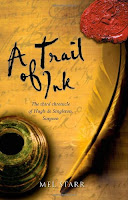
FIRST Wild Card Tour: A Trail of Ink: The Third Chronicle of Hugh de Singleton, Surgeon by Mel Starr
It is time for a FIRST Wild Card Tour book review! If you wish to join the FIRST blog alliance, just click the button. We are a group of reviewers who tour Christian books. A Wild Card post includes a brief bio of the author and a full chapter from each book toured. The reason it is called a FIRST Wild Card Tour is that you never know if the book will be fiction, non~fiction, for young, or for old...or for somewhere in between! Enjoy your free peek into the book!You never know when I might play a wild card on you!
Today's Wild Card author is:
and the book:
A Trail of Ink: The Third Chronicle of Hugh de Singleton, Surgeon
Monarch Books (February 28, 2011)
ABOUT THE AUTHOR:

Mel Starr was born and grew up in Kalamazoo, Michigan. After graduating with a MA in history from Western Michigan University in 1970, he taught history in Michigan public schools for thirty-nine years, thirty-five of those in Portage, MI, where he retired in 2003 as chairman of the social studies department of Portage Northern High School. Mel and his wife, Susan, have two daughters and seven grandchildren.
Visit the author's website.
SHORT BOOK DESCRIPTION:
Some valuable books have been stolen from Master John Wyclif, the well known scholar and Bible translator. He calls upon his friend and former pupil, Hugh de Singleton, to investigate. Hugh's investigation leads him to Oxford where he again encounters Kate, the only woman who has tempted him to leave bachelor life behind, but Kate has another serious suitor. As Hugh's pursuit of Kate becomes more successful, mysterious accidents begin to occur. Are these accidents tied to the missing books, or to his pursuit of Kate?
One of the stolen books turns up alongside the drowned body of a poor Oxford scholar. Another accident? Hugh certainly doesn’t think so, but it will take all of his surgeon’s skills to prove.
So begins another delightful and intriguing tale from the life of Hugh de Singleton, surgeon in the medieval village of Bampton. Masterfully researched by medieval scholar Mel Starr, the setting of the novel can be visited and recognized in modern-day England. Enjoy more of Hugh’s dry wit, romantic interests, evolving faith, and dogged determination as he pursues his third case as bailiff of Bampton.
Product Details:
List Price: $14.99
Paperback: 240 pages
Publisher: Monarch Books (February 28, 2011)
Language: English
ISBN-10: 1854249746
ISBN-13: 978-1854249746
AND NOW...THE FIRST CHAPTER:
I had never seen Master John Wyclif so afflicted. He was rarely found at such a loss when in disputation with other masters. He told me later, when I had returned them to him, that it was as onerous to plunder a bachelor scholar’s books as it would be to steal another man’s wife. I had, at the time, no way to assess the accuracy of that opinion, for I had no wife and few books.
But I had come to Oxford on that October day, Monday, the twentieth, in the year of our Lord 1365, to see what progress I might make to remedy my solitary estate. I left my horse at the stable behind the Stag and Hounds and went straightaway to Robert Caxton’s shop, where the stationer’s comely daughter, Kate, helped attract business from the bachelor scholars, masters, clerks, and lawyers who infest Oxford like fleas on a hound.
My pretended reason to visit Caxton’s shop was to purchase a gathering of parchment and a fresh pot of ink. I needed these to conclude my record of the deaths of Alan the beadle and of Henry atte Bridge. Alan’s corpse was found, three days before Good Friday, near to St Andrew’s Chapel, to the east of Bampton. And Henry, who it was who slew Alan, was found in a wood to the north of the town. As bailiff of Bampton Castle it was my business to sort out these murders, which I did, but not before I was attacked on the road returning from Witney and twice clubbed about the head in nocturnal churchyards. Had I known such assaults lay in my future, I might have rejected Lord Gilbert Talbot’s offer to serve as his bailiff at Bampton Castle and remained but Hugh the surgeon, of Oxford High Street.
Kate promised to prepare a fresh pot of ink, which I might have next day, and when she quit the shop to continue her duties in the workroom I spoke to her father. Robert Caxton surely knew the effect Kate had upon young men. He displayed no surprise when I asked leave to court his daughter.
I had feared raised eyebrows at best, and perhaps a refusal. I am but a surgeon and a bailiff. Surgeons own little prestige in Oxford, full of physicians as it is, and few honest men wish to see a daughter wed to a bailiff. There were surely sons of wealthy Oxford burghers, and young masters of the law, set on a path to wealth, who had eyes for the comely Kate. But Caxton nodded agreement when I requested his permission to pay court to his daughter. Perhaps my earlier service to mend his wounded back helped my suit.
I left the stationer’s shop with both joy and apprehension. The joy you will understand, or would had you seen Kate and spent time in her presence. I was apprehensive because next day I must begin a thing for which I had no training and in which I had little experience. While at Balliol College I was too much absorbed in my set books to concern myself with the proper way to impress a lass, and none of those volumes dealt with the subject. Certainly the study of logic avoided the topic. Since then my duties as surgeon and bailiff allowed small opportunity to practice discourse with a maiden. And there are few females of my age and station in Bampton.
I made my way from Caxton’s shop on Holywell Street to Catte Street and thence to the gate of Canterbury Hall, on Schidyard Street. As I walked I composed speeches in my mind with which I might impress Kate Caxton. I had forgotten most of these inventions by next day. This was just as well.
Master John Wyclif, former Master of Balliol College and my teacher there, was newly appointed Warden of Canterbury Hall. Several months earlier, frustrated at my inability to discover who had slain Alan the beadle and Henry atte Bridge, I had called upon Master John to lament my ignorance and seek his wisdom. He provided encouragement, and an empty chamber in the Hall where I might stay the night, safe from the snores and vermin at the Stag and Hounds.
When I left him those months earlier he enjoined me to call when I was next in Oxford and tell him of the resolution of these mysteries. At the time of his request I was not sure there ever would be a resolution to the business.
But there was, and so I sought Master John to tell him of it, and seek again his charity and an empty cell for the night. The porter recognized me, and sent me to Master John’s chamber. I expected to find him bent over a book, as was his usual posture when I called. But not so. He opened the door to my knock, recognized me, and blurted, “Master Hugh… they’ve stolen my books.”
The greeting startled me. I peered over the scholar’s shoulder as if I expected to see the miscreants and the plundered volumes. I saw Master John’s table, and a cupboard where his books were kept. Both were bare. He turned to follow my gaze.
“Gone,” he whispered. “All of them.”
“Who?” I asked stupidly. Had Master John known that, he would have set after the thieves and recovered the books. Or sent the sheriff to do so.
“I know not,” Wyclif replied. “I went to my supper three days past. When I returned the books were gone… even the volume I left open on my table.”
Master John is not a wealthy man. He has the living of Fillingham, and the prebend of Aust, but these provide a thin subsistence for an Oxford master of arts at work on a degree in theology. The loss of books accumulated in a life of study would be a blow to any scholar, rich or poor.
“The porter saw no stranger enter or leave the Hall while we supped,” Wyclif continued. “I went next day to the sheriff, but Sir John has other matters to mind.”
“Sir John?”
“Aye. Roger de Cottesford is replaced. The new high sheriff is Sir John Trillowe.”
“He offered no aid?”
“He sent a sergeant ’round to the stationers in the town, to see did any man come to them with books he offered to sell. Two I borrowed from Nicholas de Redyng. He will grieve to learn they are lost.”
“And the stationers… they have been offered no books?”
“None of mine missing. And Sir John has no interest, I think, in pursuing my loss further.”
The colleges have always wished to rule themselves, free of interference from the town and its government. No doubt the sheriff was minded to allow Canterbury Hall the freedom to apprehend its own thief, without his aid or interference.
“How many?”
“My books? Twenty… and the two borrowed.”
I performed some mental arithmetic. Master John read my thoughts.
“The books I borrowed from Master Nicholas… one was Bede’s Historia Ecclesiastica, worth near thirty shillings. One of mine was of paper, a cheap-set book, but the others were of parchment and well bound.”
“Your loss is great, then. Twenty pounds or more.”
“Aye,” Wyclif sighed. “Four were of my own devising. Some might say they were worth little. But the others… Aristotle, Grossteste, Boethius, all gone.”
Master John sighed again, and gazed about his chamber as if the stolen books were but misplaced, and with closer inspection of dark corners might yet be discovered.
“I am pleased to see you,” Master John continued. “I had thought to send for you.”
“For me?”
“Aye. I have hope that you will seek my stolen books and see them returned to me.”
“Me? Surely the sheriff…”
“Sir John is not interested in any crime for which the solution will not bring him a handsome fine. Rumor is he paid King Edward sixty pounds for the office. He will be about recouping his investment, not seeking stolen books.
“And you are skilled at solving mysteries,” Wyclif continued. “You found who ’twas in Lord Gilbert’s cesspit, and unless I mistake me, you know by now who killed your beadle and the fellow found slain in the forest. Well, do you not?”
“Aye. It was as I thought. Henry atte Bridge, found dead in the wood, slew Alan the beadle. Alan had followed him during the night as Henry took a haunch of venison poached from Lord Gilbert’s forest, to the curate at St Andrew’s Chapel.”
“Venison? To a priest?”
“Aye… a long story.”
“I have nothing but time, and no books with which to fill it. Tell me.”
So I told Master John of the scandal of the betrayed confessional of the priest at St Andrew’s Chapel. And of the blackmail he plotted with Henry atte Bridge – and Henry’s brother, Thomas – of those who confessed to poaching, adultery, and cheating at their business.
“I came to Oxford this day to buy more ink and parchment so I may write of these felonies while details remain fresh in my memory.”
“And what stationer receives your custom?”
“Robert Caxton. It was you who sent me first to Caxton’s shop. You knew I would find more there than books, ink, and parchment.”
“I did? Yes, I remember now telling you of the new stationer, come from Cambridge with his daughter… ah, that is your meaning. I am slow of wit these days. I think of nothing but my books.”
“You did not guess I might be interested in the stationer’s daughter?”
“Nay,” Wyclif grimaced. “I surprise myself for my lack of perception. You are a young man with two good eyes. The stationer’s daughter…”
“Kate,” I said.
“Aye, Kate is a winsome lass.”
“She is. And this day I have gained her father’s permission to seek her as my wife.”
Master John’s doleful expression brightened. The corners of his mouth and eyes lifted into a grin. “I congratulate you, Hugh.”
“Do not be too quick to do so. I must woo and win her, and I fear for my ability.”
“I have no competency in such matters. You are on your own. ’Tis your competency solving puzzles I seek.”
“But I am already employed.”
Master John’s countenance fell. “I had not considered that,” he admitted. “Lord Gilbert requires your service… and pays well for it, I imagine.”
“Aye. I am well able to afford a wife.”
“But could not the town spare you for a week or two, until my books are found? Surely a surgeon… never mind. You see how little I heed other men’s troubles when I meet my own.”
“All men think first of themselves. Why should you be different?” I asked.
“Why? Because my misplaced esteem tells me I must. Do you not wish the same, Hugh? To be unlike the commons? They scratch when and where they itch and belch when and where they will and the letters on a page are as foreign to them as Malta.”
“But… I remember a lecture…”
Wyclif grimaced.
“… when you spoke of all men being the same when standing before God. No gentlemen, no villeins, all sinners.”
“Hah; run through by my own pike. ’Tis true. I recite the same sermon each year, but though we be all sinners, and all equally in need of God’s grace, all sins are not, on earth, equal, as they may be in God’s eyes. Else all punishments would be the same, regardless of the crime.”
“And what would be a fitting penalty for one who stole twenty books?”
Wyclif scowled again. “Twenty-two,” he muttered. “My thoughts change daily,” he continued. “When I first discovered the offense I raged about the Hall threatening the thief with a noose.”
“And now?”
Master John smiled grimly. “I have thought much on that. Was the thief a poor man needing to keep his children from starvation, I might ask no penalty at all, so long as my books be returned. But if the miscreant be another scholar, with means to purchase his own books, I would see him fined heavily and driven from Oxford, and never permitted to study here again, or teach, be he a master.
“Both holy and secular wisdom,” Wyclif mused, “teach that we must not do to another what we find objectionable when done to us. No man should hold a place at Oxford who denies both God and Aristotle.”
“You think an Oxford man has done this?”
Wyclif chewed upon a fingernail, then spoke. “Who else would want my books, or know their worth?”
“That, it seems to me, is the crux of the matter,” I replied. “Some scholar wished to add to his library, or needed money, and saw your books as a way to raise funds.”
As it happened, there was a third reason a man might wish to rob Master John of his books, but that explanation for the theft did not occur to me until later.
“I am lost,” Wyclif sighed. “I am a master with no books, and I see no way to retrieve them.”
I felt guilty that, for all his aid given to me, I could offer no assistance to the scholar. I could but commiserate, cluck my tongue, and sit in his presence with a long face.
The autumn sun set behind the old Oxford Castle keep while we talked. Wyclif was about to speak again when a small bell sounded from across the courtyard.
“Supper,” he explained, and invited me to follow him to the refectory.
Scholars at Canterbury Hall are fed well, but simply. For this supper there were loaves of maslin – wheat and barley – cheese, a pease pottage flavored with bits of pork, and tankards of watered ale. I wondered at the pork, for some of the scholars were Benedictines. Students peered up from under lowered brows as we entered. They all knew of the theft, and, I considered later, suspected each other of complicity in the deed.
A watery autumn sun struggled to rise above the forest and water meadow east of Oxford when I awoke next morning. Wyclif bid me farewell with stooped shoulders and eyes dark from lack of sleep. I wished the scholar well, and expressed my prayer that his books be speedily recovered. Master John believes in prayer, but my promise to petition our Lord Christ on his behalf seemed to bring him small comfort. I think he would rather have my time and effort than my prayers. Or would have both. Prayers may be offered cheaply. They require small effort from men, and much from God. The Lord Christ has told us we may ask of Him what we will, but I suspect He would be pleased to see men set to their work, and call upon Him only when tasks be beyond them.
I thought on this as I walked through the awakening lanes of Oxford to Holywell Street and Robert Caxton’s shop. Was it really my duty to Lord Gilbert which prevented me from seeking Wyclif’s stolen books, or was I too slothful to do aught but pray for their return? I did not like the answer which came to me.
As I approached the stationer’s shop I saw a tall young man standing before it, shifting his weight from one foot to the other. The fellow was no scholar. He wore a deep red cotehardie, cut short to show a good leg. His chauces were parti-colored, grey and black, and his cap ended in a long yellow liripipe coiled stylishly about his head. The color of his cap surprised me. All who visit London know that the whores of that city are required by law to wear yellow caps so respectable maidens and wives be left unmolested on the street. He was shod in fine leather, and the pointed toes of his shoes curled up in ungainly fashion.
The fellow seemed impatient; while I watched he strode purposefully past Caxton’s shop, then reversed his steps and walked past in the opposite direction, toward my approach. I drew closer to the shop, so that at each turn I could see his face more clearly. His countenance and beard were dark, as were his eyes. The beard was neatly trimmed, and his eyes peered at my approach from above an impressive nose – although, unlike mine, his nose pointed straight out at the world, whereas mine turns to the dexter side. He seemed about my own age – twenty-five years or so. He was broad of shoulder and yet slender, but good living was beginning to produce a paunch.
I slowed my pace as I approached the shuttered shop. Caxton would open his business soon, and I assumed this dandy needed parchment, ink, or a book, although he did not seem the type to be much interested in words on a page.
I stood in the street, keeping the impatient coxcomb company, until Robert Caxton opened his shop door and pushed up his shutters to begin business for the day. The stationer looked from me to his other customer and I thought his eyes widened. I bowed to the other client and motioned him to precede me into the shop. He was there before me.
The morning sun was low in the southeast, and did not penetrate far into the shop. But dark as the place was, I could see that Kate was not within. He of the red cotehardie saw the same, and spoke before I could.
“Is Mistress Kate at leisure?” he asked.
Caxton glanced at me, then answered, “Near so. Preparing a pot of ink in the workroom. Be done shortly.”
“I’ll wait,” the fellow said with a smile. “’Tis a pleasant morning. And if Kate has no other concerns, I’d have her walk with me along the water meadow.”
He might as well have swatted me over my skull with a ridge pole. My jaw went slack and I fear both Caxton and this unknown suitor got a fine view of my tonsils.
Robert Caxton was not so discomfited that he forgot his manners. He introduced me to Sir Simon Trillowe. A knight. And of some relation to the new sheriff of Oxford, I guessed.
When he learned that I was but a surgeon and bailiff to Lord Gilbert Talbot, Sir Simon nodded briefly and turned away, his actions speaking what polite words could not: I was beneath his rank and unworthy of his consideration.
“We heard naught of you for many months, Master Hugh,” Caxton remarked.
This was true. I had neglected pursuit of Kate Caxton while about Lord Gilbert’s business in Bampton. And, to be true, I feared Kate might dismiss my suit should I press it. A man cannot be disappointed in love who does not seek it.
“No doubt a bailiff has much to occupy his time,” the stationer continued.
Sir Simon doubtless thought that I was but a customer, not that I was in competition with him for the fair Kate. He would learn that soon enough.
The door to Caxton’s workroom was open. Kate surely heard this exchange, which was a good thing. It gave her opportunity to compose herself. A moment later she entered the shop, carrying my pot of promised ink, and bestowed a tranquil smile upon both me and Sir Simon. I smiled in return, Trillowe did not. Perhaps he had guessed already that it was not ink I most wished to take from Caxton’s shop.
“Mistress Kate,” Sir Simon stepped toward her as she passed through the door. “’Tis a pleasant autumn morn… there will be few more before winter. Perhaps we might walk the path along the Cherwell… if your father can spare you for the morning.”
With these words Trillowe turned to the stationer. Caxton shrugged a reply.
“Good.” Sir Simon offered his arm and, with a brief smile and raised brows in my direction, Kate set the pot of ink on her father’s table and took Trillowe’s arm. They departed the shop wordlessly.
Caxton apparently thought some explanation in order. “You didn’t call through the summer. Kate thought you’d no interest. I told her last night you’d asked to pay court. But Sir Simon’s been by a dozen times since Lammas Day… others, too.”
“Others?”
“Aye. My Kate does draw lads to the shop. None has asked me might they pay court, though. But for you.”
“Not Sir Simon?”
“Nay. Second son of the sheriff, and a knight. He’ll not ask leave of one like me to do aught.”
“And Kate returns his interest?”
Caxton shrugged. “She’s walked out with him three times now. A knight, mind you. And son of the sheriff. Can’t blame a lass for that.”
“No,” I agreed.
“Can’t think how his father’d be pleased, though. A stationer’s daughter! A scandal in Oxford Castle when word gets out, as it surely has, by now,” Caxton mused.
“Aye. What lands his father may hold will pass to his brother. The sheriff will want Sir Simon seeking a wife with lands of her own.”
I hoped that was so. But if a second or third son acts to displease his father, it is difficult to correct him. How can a man disinherit a son who is due to receive little or nothing anyway? So if a son courting Kate Caxton displeased the sheriff of Oxford, such offense might escape retribution. This thought did not bring me joy.
But I had come to Oxford on that October day, Monday, the twentieth, in the year of our Lord 1365, to see what progress I might make to remedy my solitary estate. I left my horse at the stable behind the Stag and Hounds and went straightaway to Robert Caxton’s shop, where the stationer’s comely daughter, Kate, helped attract business from the bachelor scholars, masters, clerks, and lawyers who infest Oxford like fleas on a hound.
My pretended reason to visit Caxton’s shop was to purchase a gathering of parchment and a fresh pot of ink. I needed these to conclude my record of the deaths of Alan the beadle and of Henry atte Bridge. Alan’s corpse was found, three days before Good Friday, near to St Andrew’s Chapel, to the east of Bampton. And Henry, who it was who slew Alan, was found in a wood to the north of the town. As bailiff of Bampton Castle it was my business to sort out these murders, which I did, but not before I was attacked on the road returning from Witney and twice clubbed about the head in nocturnal churchyards. Had I known such assaults lay in my future, I might have rejected Lord Gilbert Talbot’s offer to serve as his bailiff at Bampton Castle and remained but Hugh the surgeon, of Oxford High Street.
Kate promised to prepare a fresh pot of ink, which I might have next day, and when she quit the shop to continue her duties in the workroom I spoke to her father. Robert Caxton surely knew the effect Kate had upon young men. He displayed no surprise when I asked leave to court his daughter.
I had feared raised eyebrows at best, and perhaps a refusal. I am but a surgeon and a bailiff. Surgeons own little prestige in Oxford, full of physicians as it is, and few honest men wish to see a daughter wed to a bailiff. There were surely sons of wealthy Oxford burghers, and young masters of the law, set on a path to wealth, who had eyes for the comely Kate. But Caxton nodded agreement when I requested his permission to pay court to his daughter. Perhaps my earlier service to mend his wounded back helped my suit.
I left the stationer’s shop with both joy and apprehension. The joy you will understand, or would had you seen Kate and spent time in her presence. I was apprehensive because next day I must begin a thing for which I had no training and in which I had little experience. While at Balliol College I was too much absorbed in my set books to concern myself with the proper way to impress a lass, and none of those volumes dealt with the subject. Certainly the study of logic avoided the topic. Since then my duties as surgeon and bailiff allowed small opportunity to practice discourse with a maiden. And there are few females of my age and station in Bampton.
I made my way from Caxton’s shop on Holywell Street to Catte Street and thence to the gate of Canterbury Hall, on Schidyard Street. As I walked I composed speeches in my mind with which I might impress Kate Caxton. I had forgotten most of these inventions by next day. This was just as well.
Master John Wyclif, former Master of Balliol College and my teacher there, was newly appointed Warden of Canterbury Hall. Several months earlier, frustrated at my inability to discover who had slain Alan the beadle and Henry atte Bridge, I had called upon Master John to lament my ignorance and seek his wisdom. He provided encouragement, and an empty chamber in the Hall where I might stay the night, safe from the snores and vermin at the Stag and Hounds.
When I left him those months earlier he enjoined me to call when I was next in Oxford and tell him of the resolution of these mysteries. At the time of his request I was not sure there ever would be a resolution to the business.
But there was, and so I sought Master John to tell him of it, and seek again his charity and an empty cell for the night. The porter recognized me, and sent me to Master John’s chamber. I expected to find him bent over a book, as was his usual posture when I called. But not so. He opened the door to my knock, recognized me, and blurted, “Master Hugh… they’ve stolen my books.”
The greeting startled me. I peered over the scholar’s shoulder as if I expected to see the miscreants and the plundered volumes. I saw Master John’s table, and a cupboard where his books were kept. Both were bare. He turned to follow my gaze.
“Gone,” he whispered. “All of them.”
“Who?” I asked stupidly. Had Master John known that, he would have set after the thieves and recovered the books. Or sent the sheriff to do so.
“I know not,” Wyclif replied. “I went to my supper three days past. When I returned the books were gone… even the volume I left open on my table.”
Master John is not a wealthy man. He has the living of Fillingham, and the prebend of Aust, but these provide a thin subsistence for an Oxford master of arts at work on a degree in theology. The loss of books accumulated in a life of study would be a blow to any scholar, rich or poor.
“The porter saw no stranger enter or leave the Hall while we supped,” Wyclif continued. “I went next day to the sheriff, but Sir John has other matters to mind.”
“Sir John?”
“Aye. Roger de Cottesford is replaced. The new high sheriff is Sir John Trillowe.”
“He offered no aid?”
“He sent a sergeant ’round to the stationers in the town, to see did any man come to them with books he offered to sell. Two I borrowed from Nicholas de Redyng. He will grieve to learn they are lost.”
“And the stationers… they have been offered no books?”
“None of mine missing. And Sir John has no interest, I think, in pursuing my loss further.”
The colleges have always wished to rule themselves, free of interference from the town and its government. No doubt the sheriff was minded to allow Canterbury Hall the freedom to apprehend its own thief, without his aid or interference.
“How many?”
“My books? Twenty… and the two borrowed.”
I performed some mental arithmetic. Master John read my thoughts.
“The books I borrowed from Master Nicholas… one was Bede’s Historia Ecclesiastica, worth near thirty shillings. One of mine was of paper, a cheap-set book, but the others were of parchment and well bound.”
“Your loss is great, then. Twenty pounds or more.”
“Aye,” Wyclif sighed. “Four were of my own devising. Some might say they were worth little. But the others… Aristotle, Grossteste, Boethius, all gone.”
Master John sighed again, and gazed about his chamber as if the stolen books were but misplaced, and with closer inspection of dark corners might yet be discovered.
“I am pleased to see you,” Master John continued. “I had thought to send for you.”
“For me?”
“Aye. I have hope that you will seek my stolen books and see them returned to me.”
“Me? Surely the sheriff…”
“Sir John is not interested in any crime for which the solution will not bring him a handsome fine. Rumor is he paid King Edward sixty pounds for the office. He will be about recouping his investment, not seeking stolen books.
“And you are skilled at solving mysteries,” Wyclif continued. “You found who ’twas in Lord Gilbert’s cesspit, and unless I mistake me, you know by now who killed your beadle and the fellow found slain in the forest. Well, do you not?”
“Aye. It was as I thought. Henry atte Bridge, found dead in the wood, slew Alan the beadle. Alan had followed him during the night as Henry took a haunch of venison poached from Lord Gilbert’s forest, to the curate at St Andrew’s Chapel.”
“Venison? To a priest?”
“Aye… a long story.”
“I have nothing but time, and no books with which to fill it. Tell me.”
So I told Master John of the scandal of the betrayed confessional of the priest at St Andrew’s Chapel. And of the blackmail he plotted with Henry atte Bridge – and Henry’s brother, Thomas – of those who confessed to poaching, adultery, and cheating at their business.
“I came to Oxford this day to buy more ink and parchment so I may write of these felonies while details remain fresh in my memory.”
“And what stationer receives your custom?”
“Robert Caxton. It was you who sent me first to Caxton’s shop. You knew I would find more there than books, ink, and parchment.”
“I did? Yes, I remember now telling you of the new stationer, come from Cambridge with his daughter… ah, that is your meaning. I am slow of wit these days. I think of nothing but my books.”
“You did not guess I might be interested in the stationer’s daughter?”
“Nay,” Wyclif grimaced. “I surprise myself for my lack of perception. You are a young man with two good eyes. The stationer’s daughter…”
“Kate,” I said.
“Aye, Kate is a winsome lass.”
“She is. And this day I have gained her father’s permission to seek her as my wife.”
Master John’s doleful expression brightened. The corners of his mouth and eyes lifted into a grin. “I congratulate you, Hugh.”
“Do not be too quick to do so. I must woo and win her, and I fear for my ability.”
“I have no competency in such matters. You are on your own. ’Tis your competency solving puzzles I seek.”
“But I am already employed.”
Master John’s countenance fell. “I had not considered that,” he admitted. “Lord Gilbert requires your service… and pays well for it, I imagine.”
“Aye. I am well able to afford a wife.”
“But could not the town spare you for a week or two, until my books are found? Surely a surgeon… never mind. You see how little I heed other men’s troubles when I meet my own.”
“All men think first of themselves. Why should you be different?” I asked.
“Why? Because my misplaced esteem tells me I must. Do you not wish the same, Hugh? To be unlike the commons? They scratch when and where they itch and belch when and where they will and the letters on a page are as foreign to them as Malta.”
“But… I remember a lecture…”
Wyclif grimaced.
“… when you spoke of all men being the same when standing before God. No gentlemen, no villeins, all sinners.”
“Hah; run through by my own pike. ’Tis true. I recite the same sermon each year, but though we be all sinners, and all equally in need of God’s grace, all sins are not, on earth, equal, as they may be in God’s eyes. Else all punishments would be the same, regardless of the crime.”
“And what would be a fitting penalty for one who stole twenty books?”
Wyclif scowled again. “Twenty-two,” he muttered. “My thoughts change daily,” he continued. “When I first discovered the offense I raged about the Hall threatening the thief with a noose.”
“And now?”
Master John smiled grimly. “I have thought much on that. Was the thief a poor man needing to keep his children from starvation, I might ask no penalty at all, so long as my books be returned. But if the miscreant be another scholar, with means to purchase his own books, I would see him fined heavily and driven from Oxford, and never permitted to study here again, or teach, be he a master.
“Both holy and secular wisdom,” Wyclif mused, “teach that we must not do to another what we find objectionable when done to us. No man should hold a place at Oxford who denies both God and Aristotle.”
“You think an Oxford man has done this?”
Wyclif chewed upon a fingernail, then spoke. “Who else would want my books, or know their worth?”
“That, it seems to me, is the crux of the matter,” I replied. “Some scholar wished to add to his library, or needed money, and saw your books as a way to raise funds.”
As it happened, there was a third reason a man might wish to rob Master John of his books, but that explanation for the theft did not occur to me until later.
“I am lost,” Wyclif sighed. “I am a master with no books, and I see no way to retrieve them.”
I felt guilty that, for all his aid given to me, I could offer no assistance to the scholar. I could but commiserate, cluck my tongue, and sit in his presence with a long face.
The autumn sun set behind the old Oxford Castle keep while we talked. Wyclif was about to speak again when a small bell sounded from across the courtyard.
“Supper,” he explained, and invited me to follow him to the refectory.
Scholars at Canterbury Hall are fed well, but simply. For this supper there were loaves of maslin – wheat and barley – cheese, a pease pottage flavored with bits of pork, and tankards of watered ale. I wondered at the pork, for some of the scholars were Benedictines. Students peered up from under lowered brows as we entered. They all knew of the theft, and, I considered later, suspected each other of complicity in the deed.
A watery autumn sun struggled to rise above the forest and water meadow east of Oxford when I awoke next morning. Wyclif bid me farewell with stooped shoulders and eyes dark from lack of sleep. I wished the scholar well, and expressed my prayer that his books be speedily recovered. Master John believes in prayer, but my promise to petition our Lord Christ on his behalf seemed to bring him small comfort. I think he would rather have my time and effort than my prayers. Or would have both. Prayers may be offered cheaply. They require small effort from men, and much from God. The Lord Christ has told us we may ask of Him what we will, but I suspect He would be pleased to see men set to their work, and call upon Him only when tasks be beyond them.
I thought on this as I walked through the awakening lanes of Oxford to Holywell Street and Robert Caxton’s shop. Was it really my duty to Lord Gilbert which prevented me from seeking Wyclif’s stolen books, or was I too slothful to do aught but pray for their return? I did not like the answer which came to me.
As I approached the stationer’s shop I saw a tall young man standing before it, shifting his weight from one foot to the other. The fellow was no scholar. He wore a deep red cotehardie, cut short to show a good leg. His chauces were parti-colored, grey and black, and his cap ended in a long yellow liripipe coiled stylishly about his head. The color of his cap surprised me. All who visit London know that the whores of that city are required by law to wear yellow caps so respectable maidens and wives be left unmolested on the street. He was shod in fine leather, and the pointed toes of his shoes curled up in ungainly fashion.
The fellow seemed impatient; while I watched he strode purposefully past Caxton’s shop, then reversed his steps and walked past in the opposite direction, toward my approach. I drew closer to the shop, so that at each turn I could see his face more clearly. His countenance and beard were dark, as were his eyes. The beard was neatly trimmed, and his eyes peered at my approach from above an impressive nose – although, unlike mine, his nose pointed straight out at the world, whereas mine turns to the dexter side. He seemed about my own age – twenty-five years or so. He was broad of shoulder and yet slender, but good living was beginning to produce a paunch.
I slowed my pace as I approached the shuttered shop. Caxton would open his business soon, and I assumed this dandy needed parchment, ink, or a book, although he did not seem the type to be much interested in words on a page.
I stood in the street, keeping the impatient coxcomb company, until Robert Caxton opened his shop door and pushed up his shutters to begin business for the day. The stationer looked from me to his other customer and I thought his eyes widened. I bowed to the other client and motioned him to precede me into the shop. He was there before me.
The morning sun was low in the southeast, and did not penetrate far into the shop. But dark as the place was, I could see that Kate was not within. He of the red cotehardie saw the same, and spoke before I could.
“Is Mistress Kate at leisure?” he asked.
Caxton glanced at me, then answered, “Near so. Preparing a pot of ink in the workroom. Be done shortly.”
“I’ll wait,” the fellow said with a smile. “’Tis a pleasant morning. And if Kate has no other concerns, I’d have her walk with me along the water meadow.”
He might as well have swatted me over my skull with a ridge pole. My jaw went slack and I fear both Caxton and this unknown suitor got a fine view of my tonsils.
Robert Caxton was not so discomfited that he forgot his manners. He introduced me to Sir Simon Trillowe. A knight. And of some relation to the new sheriff of Oxford, I guessed.
When he learned that I was but a surgeon and bailiff to Lord Gilbert Talbot, Sir Simon nodded briefly and turned away, his actions speaking what polite words could not: I was beneath his rank and unworthy of his consideration.
“We heard naught of you for many months, Master Hugh,” Caxton remarked.
This was true. I had neglected pursuit of Kate Caxton while about Lord Gilbert’s business in Bampton. And, to be true, I feared Kate might dismiss my suit should I press it. A man cannot be disappointed in love who does not seek it.
“No doubt a bailiff has much to occupy his time,” the stationer continued.
Sir Simon doubtless thought that I was but a customer, not that I was in competition with him for the fair Kate. He would learn that soon enough.
The door to Caxton’s workroom was open. Kate surely heard this exchange, which was a good thing. It gave her opportunity to compose herself. A moment later she entered the shop, carrying my pot of promised ink, and bestowed a tranquil smile upon both me and Sir Simon. I smiled in return, Trillowe did not. Perhaps he had guessed already that it was not ink I most wished to take from Caxton’s shop.
“Mistress Kate,” Sir Simon stepped toward her as she passed through the door. “’Tis a pleasant autumn morn… there will be few more before winter. Perhaps we might walk the path along the Cherwell… if your father can spare you for the morning.”
With these words Trillowe turned to the stationer. Caxton shrugged a reply.
“Good.” Sir Simon offered his arm and, with a brief smile and raised brows in my direction, Kate set the pot of ink on her father’s table and took Trillowe’s arm. They departed the shop wordlessly.
Caxton apparently thought some explanation in order. “You didn’t call through the summer. Kate thought you’d no interest. I told her last night you’d asked to pay court. But Sir Simon’s been by a dozen times since Lammas Day… others, too.”
“Others?”
“Aye. My Kate does draw lads to the shop. None has asked me might they pay court, though. But for you.”
“Not Sir Simon?”
“Nay. Second son of the sheriff, and a knight. He’ll not ask leave of one like me to do aught.”
“And Kate returns his interest?”
Caxton shrugged. “She’s walked out with him three times now. A knight, mind you. And son of the sheriff. Can’t blame a lass for that.”
“No,” I agreed.
“Can’t think how his father’d be pleased, though. A stationer’s daughter! A scandal in Oxford Castle when word gets out, as it surely has, by now,” Caxton mused.
“Aye. What lands his father may hold will pass to his brother. The sheriff will want Sir Simon seeking a wife with lands of her own.”
I hoped that was so. But if a second or third son acts to displease his father, it is difficult to correct him. How can a man disinherit a son who is due to receive little or nothing anyway? So if a son courting Kate Caxton displeased the sheriff of Oxford, such offense might escape retribution. This thought did not bring me joy.
Wednesday, March 09, 2011
When You Come Home
I took a break from reviewing during the last year because of my mother's declining health. Over the last few years her dementia started taking her memories. In the fall, we had to move her to a home. It was hard on everyone but we were not in a position to give her 24 hour care. On March 6, the Lord called her home. While we are sad that we can't talk to her anymore we have to be thankful that she is no longer suffering. My little 6 year old nephew summed it up best. He said "...so Grandma went to live with Jesus. That's a good thing."
I plan on dedicating this site to her memory. Her life was a great example of the unconditional love of Christ. Even if she didn't agree with what you were doing, you always knew that she loved you.
She had a gift that she didn't even realize. Anyone who talked to her knew that she genuinely cared about them. You had her undivided attention. This is something that Jesus demonstrated to us in the Gospels. In this day and age, more than ever, we need to take the time to listen to other people. Do not rush through life and miss out on opportunities to demonstrate Christ's love to others. You never know when that person you don't take the time to talk to needs sometime to talk to. You might make the difference that saves their life.
As I reflect on everything that my mom did for me, I keep being reminded of a song by Mark Schultz. Go out and buy "When You Come Home". If you mother is still alive you will want to run to her and give her a hug. If she has gone to heaven, you know she will be waiting when you come home.
(lyrics copyright by Mark Schultz)
My first day of recess
They all laughed at me
When I fell off the swing set
And scraped up my knee
The nurse called my Momma
To say I'd be late,
And when she gave me the phone
I could hear Momma say
"I'm so sorry, son.
Oh I think you're' so brave"
And she was smilin when she said:
When you come home,
No matter how far,
run through the door
And into my arms
It's where you are loved,
It's where you belong
And I will be here
When you come home
I waved good-bye through the window
As I boarded the plane,
My first job in Houston
Was waiting for me
I found a letter from Momma
Tucked in my coat
And as I flew down the runway
I smiled when she wrote:
I'll miss you, son,
You'll be so far away
But I'll be waiting for the day
When you come home
No matter how far,
Run through the door
And into my arms
It's where you are loved,
It's where you belong,
And I will be here
When you come home
Well, I don't think
She can hear you now,
The doctor told me
Your mother is fading,
It's best that you leave
So I whispered,
I love you
And then turned away.
But I stopped at the door
When I heard Momma say,
I love you, son,
But they're callin me away
Promise me before I go
When you come home,
No matter how far,
Run through the door
And into my arms;
It's where you are loved,
It's where you belong,
And I will be here
When you come home,
When you come home.
I plan on dedicating this site to her memory. Her life was a great example of the unconditional love of Christ. Even if she didn't agree with what you were doing, you always knew that she loved you.
She had a gift that she didn't even realize. Anyone who talked to her knew that she genuinely cared about them. You had her undivided attention. This is something that Jesus demonstrated to us in the Gospels. In this day and age, more than ever, we need to take the time to listen to other people. Do not rush through life and miss out on opportunities to demonstrate Christ's love to others. You never know when that person you don't take the time to talk to needs sometime to talk to. You might make the difference that saves their life.
As I reflect on everything that my mom did for me, I keep being reminded of a song by Mark Schultz. Go out and buy "When You Come Home". If you mother is still alive you will want to run to her and give her a hug. If she has gone to heaven, you know she will be waiting when you come home.
(lyrics copyright by Mark Schultz)
My first day of recess
They all laughed at me
When I fell off the swing set
And scraped up my knee
The nurse called my Momma
To say I'd be late,
And when she gave me the phone
I could hear Momma say
"I'm so sorry, son.
Oh I think you're' so brave"
And she was smilin when she said:
When you come home,
No matter how far,
run through the door
And into my arms
It's where you are loved,
It's where you belong
And I will be here
When you come home
I waved good-bye through the window
As I boarded the plane,
My first job in Houston
Was waiting for me
I found a letter from Momma
Tucked in my coat
And as I flew down the runway
I smiled when she wrote:
I'll miss you, son,
You'll be so far away
But I'll be waiting for the day
When you come home
No matter how far,
Run through the door
And into my arms
It's where you are loved,
It's where you belong,
And I will be here
When you come home
Well, I don't think
She can hear you now,
The doctor told me
Your mother is fading,
It's best that you leave
So I whispered,
I love you
And then turned away.
But I stopped at the door
When I heard Momma say,
I love you, son,
But they're callin me away
Promise me before I go
When you come home,
No matter how far,
Run through the door
And into my arms;
It's where you are loved,
It's where you belong,
And I will be here
When you come home,
When you come home.
Wednesday, January 20, 2010
CFBA Tour-A Lady Like Sarah by Margaret Brownley
ABOUT THE AUTHOR:
Thrills, mystery, suspense, romance: Margaret penned it all. Nothing wrong with this, except Margaret happened to be writing for the church newsletter. After making the church picnic read like a Grisham novel, her former pastor took her aside and said, "Maybe God's calling you to write fiction."
It turns out God was and Margaret did. She now has more than 20 novels to her credit. In addition, she's written many Christian articles and a non-fiction book. Still, it took a lot of prodding from God before Margaret tried her hand at writing inspirational fiction which led to her Rocky Creek series. "I love writing about characters at different stages of faith," she says of the new direction her writing career has taken, "and I'm here to stay."
Happily married to her real-life hero, Margaret and her husband live in Southern California.
ABOUT THE BOOK
Sarah Prescott has never known a respectable life; just a hardscrabble childhood and brothers who taught her to shoot straight.
Justin Wells left Boston in disgrace, heading out alone on the dusty trail to Texas. But when the once-respected clergyman encounters a feisty redhead in handcuffs with a dying US Marshall at her side, their journey takes a dramatic turn.
His high society expectations and Sarah's outlaw habits clash from the start. With a price on her head and a sweet orphan in tow, Justin and Sarah make the difficult journey toward Rocky Creek. There justice will be meted out hopefully with a portion of grace.
If you would like to read the first chapter of A Lady Like Sarah, go HERE
Watch the Book Trailer:
Wednesday, September 23, 2009
CFBA Tour-One Imperfect Christmas by Myra Johnson
ABOUT THE AUTHOR:
Making up stories has been second nature to me for as long as I can remember. A select group of trusted friends back at dear old Mission High waited eagerly for the next installment of my "Great American Spy Novel" (think Man from Uncle) and my "All-American Teen Novel" (remember Gidget and Tammy?). I even had a private notebook of angst-ridden poetry a la Rod McKuen.The dream of writing persisted into adulthood, although it often remained on the back burner while I attended to home and family and several "real" (read paying) jobs along the way. Then in 1983, while recovering from sinus surgery, I came upon one of those magazine ads for the Institute of Children’s Literature. I knew it was time to get serious, and the next thing I knew, I'd enrolled in the “Writing for Children and Teenagers” course.
Within a year or so I sold my first story, which appeared in the Christian publication Alive! for Young Teens. For many years I enjoyed success writing stories and articles for middle-graders and young adults. I even taught for ICL for 9 years.
Then my girls grew up, and there went my live-in inspiration. Time to switch gears. I began my first women's fiction manuscript and started attending Christian writers conferences. Eventually I learned about American Christian Romance Writers (which later became American Christian Fiction Writers) and couldn't wait to get involved. Friends in ACFW led me to RWA and the online inspirational chapter, Faith, Hope & Love.
So here I am today, still on this crazy roller-coaster ride. Still writing. Still hopeful. Writing, I'm learning, is not about the destination, it's about the journey. My current projects are primarily women's fiction and romance . . . novels of hope, love, and encouragement. Novels about real women living out their faith and finding love in the midst of everyday, and sometimes not so everyday, situations.
ABOUT THE BOOK

Graphic designer Natalie Pearce faces the most difficult Christmas of her life. For almost a year, her mother has lain in a nursing home, the victim of a massive stroke, and Natalie blames herself for not being there when it happened. Worse, she's allowed the monstrous load of guilt to drive a wedge between her and everyone she loves-most of all her husband Daniel. Her marriage is on the verge of dissolving, her prayer life is suffering, and she's one Christmas away from hitting rock bottom.
Junior-high basketball coach Daniel Pearce is at his wit's end. Nothing he's done has been able to break through the wall Natalie has erected between them. And their daughter Lissa's adolescent rebellion isn't helping matters. As Daniel's hope reaches its lowest ebb, he wonders if this Christmas will spell the end of his marriage and the loss of everything he holds dear.
If you would like to read the first chapter of One Imperfect Christmas, go HERE
Watch the trailer:
Wednesday, September 16, 2009
CFBA Tour-Tidings of Great Boys by Shelley Adina
ABOUT THE AUTHOR:
Award-winning author Shelley Adina wrote her first teen novel when she was 13. It was rejected by the literary publisher to whom she sent it, but he did say she knew how to tell a story. That was enough to keep her going through the rest of her adolescence, a career, a move to another country, a B.A. in Literature, an M.A. in Writing Popular Fiction, and countless manuscript pages.Shelley is a world traveler and pop culture junkie with an incurable addiction to designer handbags. She writes books about fun and faith--with a side of glamour. Between books, Shelley loves traveling, playing the piano and Celtic harp, watching movies, and making period costumes.
ABOUT THE BOOK
Finals week is approaching and Mac is still undecided on where to spend the holidays. Normally she'd go home to Scotland, but spending two weeks alone in the castle with her dad isn't as appealing as it used to be. So she invites Carly, Lissa, Gillian, and Shani to join her for the holidays!Mac is determined to make this the best Christmas ever. She even decides to organize the traditional Hogmany dance for New Year's Eve. If she can get her mother involved in the dance, maybe her parents will finally get back together.
But when Mac and the girls arrive in Scotland, they are faced with bad news: the castle is falling apart and Mac's parents are struggling financially. Not only that, but Shani is in big trouble with Prince Rashid's royal family. Can the girls find a way to celebrate the holidays, get Mac's parents back together, save the castle, and rescue Shani from her relentless pursuers? There's only one way to find out...
If you would like to read the first chapter of Tidings of Great Boys, go HERE
Tuesday, August 18, 2009
CSFF Blog Tour-Offworld by Robin Parrish
It's time for the August Christian Sci Fi and Fantasy Blog Tour. This month's featured novel is Offworld by Robin Parrish. In summary, the book is about a what happens when a mission to Mars is over and the crew return to Earth. The catch is all of the people have vanished(time for the Twilight Zone music).
My full review will appear later at the Christian Fiction Library site.
Reading this story brought back memories of other science fiction stories dealing with loneliness. A few of my favorites are...
1. George R. R. Martin's Dying of the Light. A man is asked by a former lover to meet her on a strange planet.
2. J. G. Ballard's Hello America. The rediscovery of America 100 years after it is abandoned.
3. Twilight Zone episode-Time Enough at Last. A man who loves to read survives a nuclear explosion and is left alone with a library.
4. Twilight Zone episode-Five Characters in Search of an Exit. Five people find themselves trapped in a giant cylinder with no idea who they are or how they got there.
Has the atmosphere of Offworld reminded you of any other stories?
Please take the time to visit the other sites participating in the tour.
Brandon Barr
Justin Boyer
Keanan Brand
Gina Burgess
Canadianladybug
Melissa Carswell
Valerie Comer
Karri Compton
Amy Cruson
CSFF Blog Tour
Stacey Dale
D. G. D. Davidson
Jeff Draper
April Erwin
Karina Fabian
Linda Gilmore
Beth Goddard
Todd Michael Greene
Katie Hart
Ryan Heart
Becky Jesse
Cris Jesse
Jason Joyner
Julie
Carol Keen
Krystine Kercher
Dawn King
Melissa Meeks
Rebecca LuElla Miller
Mirtika
Eve Nielsen (posting later in the week)
Nissa
John W. Otte
Lyn Perry
Steve Rice
Chawna Schroeder
James Somers
Speculative Faith
Stephanie
Rachel Starr Thomson
Steve Trower
Fred Warren
Dona Watson
Elizabeth Williams
Subscribe to:
Posts (Atom)